For many care-experienced people, accessing your records can feel like an important step. You may hope for answers, want to fill gaps in your memory, understand decisions that were made about your life, or finally make sense of a childhood that often felt confusing and chaotic. Sometimes you believe that somewhere in those files there will be clarity.
What no one tells you is that accessing your care records can also be one of the most emotionally difficult things you ever do.
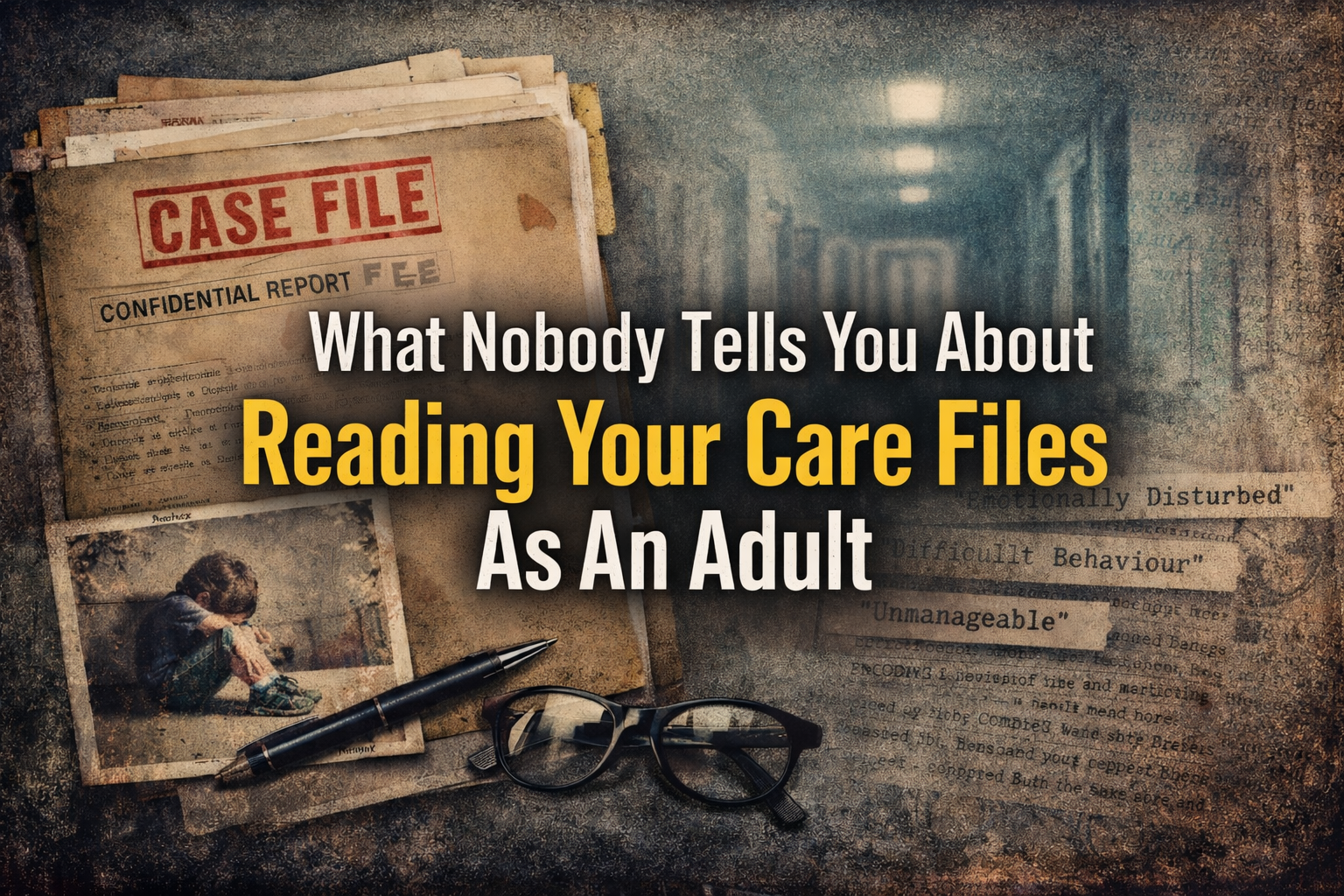
When you open those files, you are not simply reading dates, placements, and meeting notes. You are reading how other people described you when you were a child. You are reading reports written by social workers, carers, teachers, psychologists, managers, and professionals who held power over your life. You are reading their opinions, interpretations, frustrations, and assumptions.
Sometimes you are reading things that feel deeply unfair.
For many care-experienced adults, the shock is not only what happened to us. It is seeing how what happened was recorded. Language can be cold. Labels can be harsh. Behaviour is often documented in detail while the reasons behind it are barely acknowledged. Distress becomes “challenging behaviour.” Fear becomes “non-compliance.” Trauma responses become “disruption.” The child disappears, and the behaviour remains.
There is a common belief that official records are objective truth. They are not.
Care files are written by people, and people bring bias into everything they write. They bring personal judgement, professional culture, assumptions about class and family, emotional reactions, incomplete information, and sometimes simple carelessness. Some records contain misunderstandings. Others exaggerate. Some repeat rumours or second-hand claims as fact. Some things are left out entirely.
In some cases, there are statements that are simply untrue.
That can be a devastating thing to discover as an adult. That an official version of your childhood exists, and parts of it are inaccurate.
What was written about you often carried real consequences at the time. Those words could shape placements, risk assessments, decisions about contact, mental health referrals, school support, how seriously you were taken, and how future professionals viewed you before ever meeting you. A label written once can follow you for years.
Then adulthood arrives, and many of us are told that accessing our files may bring closure. Sometimes it does bring understanding. But it can also reopen wounds.
You may find yourself reading thousands of pages that reduce your childhood to incidents, behaviours, sanctions, concerns, and professional observations. You are confronted with how adults narrated your life while you were living it. That can be soul-destroying.
It is important to know that you can challenge inaccuracies in your records. You may be able to request corrections, raise concerns, ask for a statement of disagreement to be added, or have an amendment attached explaining your position. That matters, and your voice matters.
But another truth people are rarely told is this: challenging records does not erase what was originally written. In many cases, the original wording remains on file. At best, an amendment, note, or attached statement may be added alongside it. While you may be able to contest falsehoods, you often cannot undo the fact that they were written in the first place, or the impact they may already have had.
If you are thinking of accessing your files, please treat it as something serious. This is not like casually looking through old paperwork. These records can contain trauma, judgement, inaccuracies, and painful reminders of times when you had little control.
If you choose to do it, have emotional support in place if possible. Read in small sections rather than all at once. Take breaks when needed. Stop when it becomes too much. Remind yourself often that these records are one version of events, not the full truth of your life.
You do not owe anyone a full reading in one go.
To other care-experienced people, if you have read your records and felt angry, numb, confused, hurt, or overwhelmed, you are not alone. If you found lies, bias, or language that made you feel ashamed, you are not alone. If reading them changed how you understand your childhood, you are not alone.
Many of us are forced to meet our younger selves through paperwork written by strangers. That is a heavy thing to carry.
Accessing your care records can be important. It can answer questions and restore missing pieces. But it can also expose how systems saw you, judged you, and documented you.
Those files may contain words written about you, but they do not contain the whole truth of who you were, and they certainly do not define who you are now.
Leave a Reply