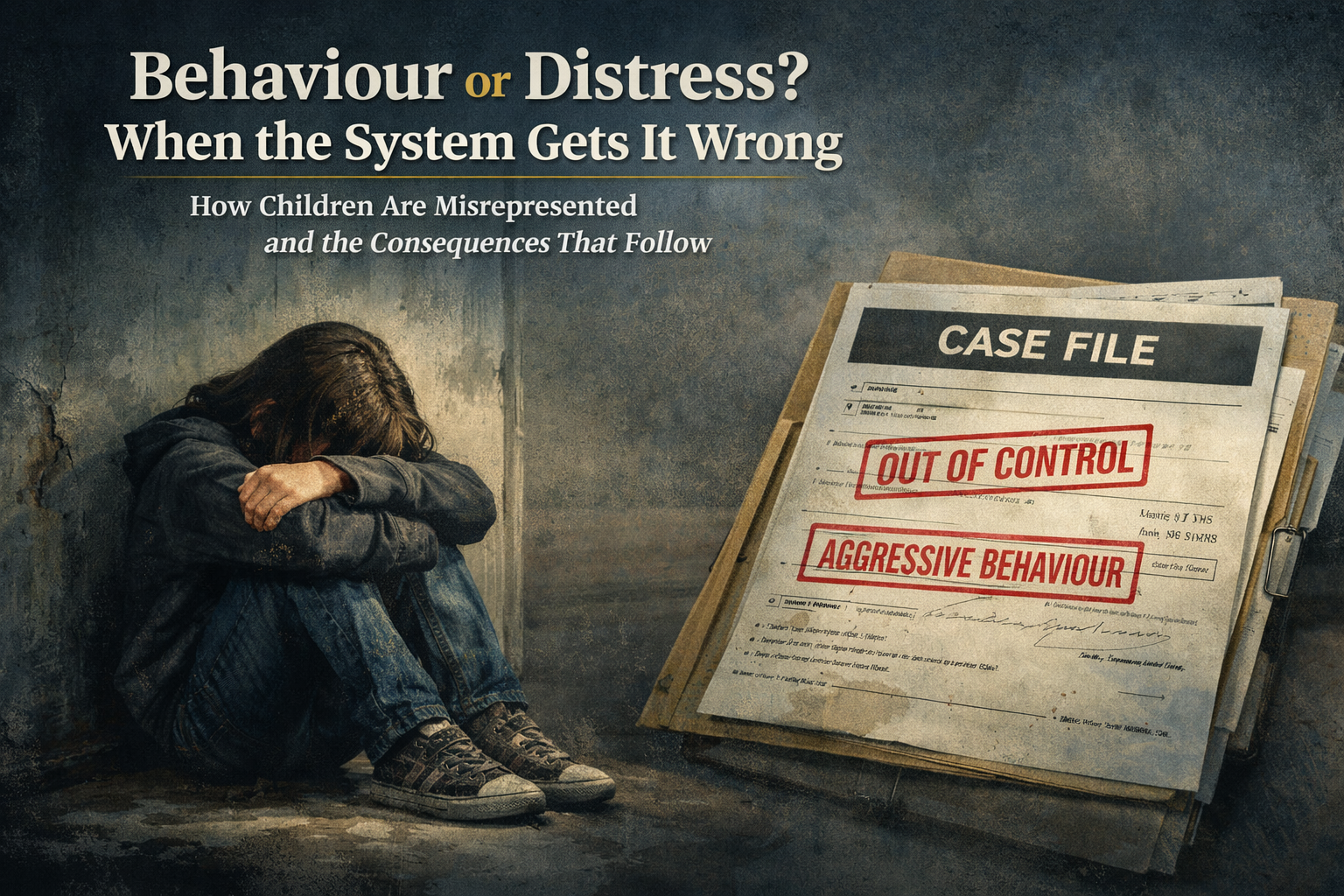
Behaviour or Distress? When the System Gets It Wrong How Children Are Misrepresented and the Consequences That Follow
At 13 years old, a file was created.
Inside it were words that would shape how a child was seen, words like “out of parental control.” Words that carry authority. Words that influence how professionals interpret behaviour, assess risk, and make decisions that can alter the course of a young person’s life.
But a file cannot hold context. It cannot capture what it feels like to grow up in an environment where relationships are breaking down, where emotional safety is uncertain, or where a child is trying to navigate situations they do not yet have the language to explain. It records what is visible. It rarely captures what sits underneath.
In many cases, when concerns are raised about a child, systems respond as they are designed to do. Schools notice changes. Professionals become involved. Information is gathered. Assessments are made.
But those assessments depend heavily on the information they are given.
And that information is not always neutral.
In practice, much of what is written about a child comes from adult accounts often from parents or caregivers. These accounts are frequently treated as reliable starting points, sometimes without being fully tested against the wider context of the child’s life. Yet parents, like anyone else, bring their own perspectives, their own limitations, and sometimes their own unresolved difficulties.
There are situations where a parent’s account may not fully reflect reality. There are situations where conflict is reframed as defiance, where a child’s distress is described as disobedience, and where complex family dynamics are reduced to a simple narrative: That the child is the problem.
When that happens, language becomes powerful in the wrong way.
A phrase like “out of parental control” does more than describe behaviour, it assigns responsibility. It places the weight of the situation onto the child, rather than asking what might be happening around them. It closes down questions that should be asked and replaces them with conclusions that are too quickly accepted.
But behaviour does not exist in isolation.
Children do not become “difficult” without reason. What is often labelled as defiance can be a response to instability. What is described as aggression can be a reaction to emotional harm. What is seen as disruption can be an expression of overwhelm.
One of the most misunderstood aspects of child behaviour is what is sometimes referred to as “reactive abuse” a term that remains debated, but which points to something important: The way a person may respond to ongoing harm.
Consider a hypothetical case.
A young girl is growing up in a home where she is frequently belittled by her mother. She is told she is difficult, ungrateful, or a problem. At times, she is denied basic needs such as consistent access to food. There are moments of physical aggression being grabbed, handled roughly, or hurt in ways that are minimised or dismissed.
This is her normal.
She does not yet have the language to describe emotional abuse. She does not have the tools to regulate the intensity of what she feels. She is learning, in real time, how to survive in an environment that is unpredictable and, at times, unsafe.
Over time, her behaviour begins to change.
She becomes reactive. She argues back. She shouts. And in moments where she is physically confronted, she lashes out. On one occasion, she injures her mother while trying to defend herself or break free.
From the outside, this moment can be isolated, documented, and interpreted.
A report may state that the child is aggressive. That she has caused harm to a parent. That she is escalating. That she is, perhaps, “out of control.”
But what is missing from that account is everything that led up to it.
The prolonged belittling. The emotional harm. The fear. The unmet needs. The absence of safety. The fact that this child is not initiating harm, but responding to it in the only way she currently knows how.
Without that context, her reaction becomes the focus and the environment that shaped it disappears.
This is the risk.
When responses to harm are recorded without acknowledging the harm itself, that narrative shifts. The child becomes the problem. The behaviour becomes the issue to manage. And the original source of distress is left unexamined.
In these situations, the question should not simply be “Why did she react like that?”
It should also be “What was she reacting to?”
When systems focus only on what a child is doing, without fully understanding what a child is experiencing, there is a risk of getting it wrong.
And when systems get it wrong, the consequences are not small.
Labels written in early reports do not stay contained. They follow children through schools, through services, and into healthcare settings. They shape expectations before a child has the chance to speak for themselves. They influence how behaviour is interpreted, how risk is assessed, and how credibility is assigned.
Over time, a version of that child is constructed on paper one that may be incomplete or, in some cases, fundamentally inaccurate.
And that version can become more powerful than the child themselves.
This is particularly concerning in situations where a child’s voice is already limited. Children often do not have the language, confidence, or safety to fully explain what they are experiencing. Their accounts may be dismissed, minimised, or overshadowed by adult narratives that are seen as more reliable.
But reliability should not be assumed, it should be examined.
Systems designed to protect children must be able to hold complexity. They must be willing to question whether the information they are receiving tells the full story. They must recognise that not all behaviour is a problem to be controlled sometimes it is a signal to be understood.
This is not about suggesting that all parental accounts are inaccurate, or that professionals act without care. It is about recognising a structural risk: When one narrative is given more weight than others, especially in high-stakes decisions, the margin for error becomes dangerously small.
And when that error falls on a child, the impact can shape identity, relationships, and life outcomes for years to come.
The question, then, is not simply how systems respond to behaviour but how they interpret it.
Do they ask what a child is doing?
Or do they ask what has happened to them?
Because the difference between those two questions can change everything.
And in the lives of children, getting that wrong is not just a mistake.
It is a consequence they carry with them.