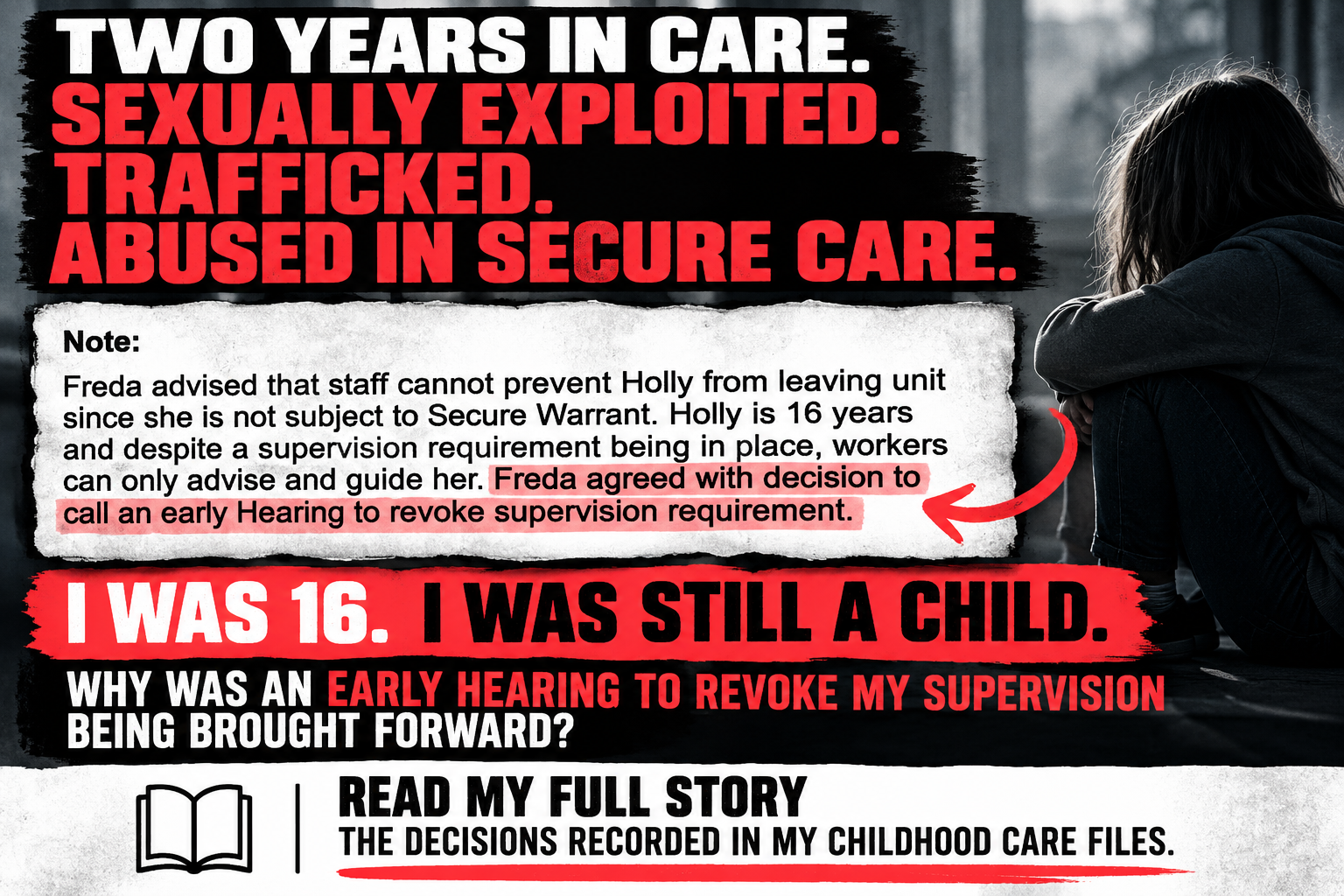
When I look back at my childhood records, I am left questioning how a child could experience repeated sexual exploitation, trafficking and abuse, yet still find herself in a position where professionals were discussing withdrawing statutory supervision.
There are some things you read in your childhood records that make you angry. There are others that leave you genuinely horrified. This is one of them. By the time I was 16 years old, I had already spent approximately two years within the care system. I had entered care at 14, and my teenage years had been marked by sexual exploitation and trafficking around Edinburgh, by a group of men.
But to understand why this particular case record is so deeply disturbing, it is important to understand what had happened to me before this professional discussion took place.
As I explained, I had already experienced sexual exploitation and trafficking before being placed in secure care. I subsequently spent six months in secure accommodation. During that time, I was sexually abused by a member of the care staff responsible for looking after me.
Think about that for a moment.
A child who had already experienced sexual exploitation was placed somewhere that was supposed to provide safety, protection and security, only to experience further sexual abuse at the hands of someone employed to care for her. The very environment that was supposed to protect me became another place where I experienced sexual abuse.
The sexual abuse I experienced in secure care was not dealt with properly. The consequences of that abuse were not something I could simply leave behind when I walked out of the building.
Following my release from secure care, I was placed in close support. But the risks that had contributed to my exploitation in the first place had not simply disappeared. I was effectively returning to the very dangers from which I had supposedly needed protection. I struggled enormously. I returned to drugs and alcohol, and during this period I was exploited and trafficked again.
This is important context because my vulnerability was not new, unexpected or unknown. There was an established history of sexual exploitation, further sexual abuse within a care setting, unresolved trauma and repeated exposure to serious harm. And against that background, I want people to read the following professional record and consider what it actually says.
The professional discussion that I cannot ignore
The record documents a consultation with Freda (PTM). It states:
“Freda advised that staff cannot prevent Holly from leaving unit since she is not subject to Secure Warrant. Holly is 16 years and despite a supervision requirement being in place, workers can only advise and guide her. Freda agreed with decision to call an early Hearing to revoke supervision requirement.”
I have read those words repeatedly.
And the more I consider the circumstances I was living in at the time, the more difficult I find them to accept.
This was not a 16-year-old with no known history of vulnerability.
This was not a young person whose risks had suddenly emerged.
This was a child who had already experienced sexual exploitation and trafficking, had spent six months in secure care, had subsequently been sexually abused by a care worker, and had returned to circumstances in which she was vulnerable to further exploitation. I was struggling with the consequences of everything that had happened to me. I was using drugs and alcohol. I was being exploited and trafficked again.
And the recorded professional discussion turned towards bringing forward an early Children’s Hearing to seek revocation of my supervision requirement.
I find that absolutely appalling.
How does a child reach this point in their life, with this history of abuse and exploitation, and the conversation becomes about revoking their supervision requirement?
Since when did being unable to physically restrain a child mean there was nothing more to do?
I understand the point being made in the record about the absence of a Secure Warrant. I understand that staff could not physically prevent me from leaving the children’s home.
But that is not the point.
The inability to physically prevent a child from leaving does not remove the responsibility to safeguard that child.
What were professionals doing to address the reasons I was leaving? What was being done about the people exploiting me? What action had been taken to address the sexual abuse I had experienced in secure care? What was being done to understand why I was repeatedly ending up in dangerous situations?
Where was the urgency around the fact that I had been sexually exploited and trafficked more than once?
Where was the recognition that my behaviour might have been a manifestation of trauma, abuse and exploitation?
And, most importantly, what safeguarding plan was in place if my supervision requirement was revoked?
I cannot help but feel that the focus had shifted towards managing the difficulties my circumstances presented to professionals, rather than addressing the circumstances that were putting me in danger.
It is deeply concerning to read a record that discusses what staff cannot do, without any corresponding explanation of what more could be done to protect me.
And before anyone says, “But you were 16…”
I want to address this because I already anticipate that some people will look at this situation and argue that I was 16, that I was old enough to make my own decisions, or that professionals could not physically prevent me from leaving a children’s home.
So, let’s be absolutely clear about something.
I Was Still A Child
Under the Scottish Government’s National Guidance for Child Protection in Scotland (2021, updated 2023), child protection applies to children and young people under the age of 18.
There are different legal definitions of childhood across Scottish legislation, and 16- and 17-year-olds have certain additional legal rights and responsibilities. However, reaching the age of 16 does not automatically remove a young person from the scope of child protection.
I want that distinction to be understood because I was not an adult. I was a child in the care system, experiencing some of the most serious forms of abuse and exploitation.
I had entered care at 14. By 16, I had already experienced sexual exploitation and trafficking, spent six months in secure care where I was sexually abused by a member of staff, and subsequently experienced further exploitation and trafficking following my release.
My sixteenth birthday did not erase any of that.
It did not make me less vulnerable. It did not make me responsible for protecting myself from traffickers and sexual predators. It did not mean that professionals could simply step back from their safeguarding responsibilities.
And it certainly did not mean that I no longer needed statutory oversight, support or protection.
A 16-year-old being sexually exploited is still a child being sexually exploited.
A 16-year-old being trafficked is still a child being trafficked.
A child who has experienced sexual abuse in the very system entrusted with their care should not be left to navigate the consequences alone.
I was 16, not an adult. I was still a child under Scottish child protection guidance.
What exactly was the plan for protecting me?
This is ultimately what I want answers to.
When professionals were discussing bringing forward an early hearing to revoke my supervision requirement:
- What consideration was given to my established history of sexual exploitation and trafficking?
- What action had been taken following the sexual abuse I experienced in secure care?
- Had the impact of that abuse on my emotional wellbeing, behaviour and substance use been properly assessed?
- What consideration was given to the fact that I was being exploited and trafficked again?
- Why was an early hearing to seek revocation considered appropriate?
- What alternative safeguarding arrangements were being proposed?
- Was my own experience and perspective considered?
- Who was taking responsibility for protecting me if statutory supervision ended?
I want to know whether anyone stepped back and looked at the whole picture of my childhood.
Because when I look at it now, I see a child who had experienced repeated abuse and exploitation, including within a setting that was supposed to protect her.
I see a child whose trauma had not been properly addressed, who was returned to circumstances where she was vulnerable to further exploitation, and whose difficulties were being discussed in professional meetings.
I want to know why the focus was not on what more could be done to protect me.
Children should not have to become adults to question why nobody protected them.
I am now an adult looking back at records documenting decisions that were being discussed while I was still a child. I cannot change what happened. I cannot undo the sexual exploitation, the trafficking, the abuse in secure care or the trauma that followed.
But I can question the professional decisions made around me.
I can ask why the abuse I experienced in secure care was not properly addressed.
I can ask why I was returned to circumstances in which I was vulnerable to further exploitation.
I can ask why, when the risks were so serious, the discussion turned towards revoking my supervision requirement.
And I can ask why a child with such an extensive history of abuse and exploitation was not receiving the level of protection she desperately needed.
I do not believe that a child’s repeated exposure to exploitation should ever become so normalised within a care system that removing statutory oversight becomes a reasonable-sounding response.
Children do not stop needing protection because they are difficult to safeguard.
They do not become responsible for their own exploitation because they use drugs or alcohol.
They do not become adults simply because they reach their sixteenth birthday.
And they should never have to experience abuse within the very institutions entrusted with their safety.
I was 16. I had already endured more than most children should ever have to experience in a lifetime. I needed adults to step up, not for the system to consider stepping further away.
Because behind that case note was a real 16-year-old girl.
A girl who had already been failed in ways that no child should experience.
A girl who needed protection, stability, compassion and adults willing to take responsibility.
That girl was me.
And I will not stay silent about what happened to her.
Legal context and further reading
Scottish Government – National Guidance for Child Protection in Scotland 2021 (updated 2023).
This guidance recognises that child protection applies to children and young people under 18, while acknowledging that different legislation may define childhood differently and that particular legal provisions apply to 16- and 17-year-olds.
Note: This blog reflects my personal experiences, my recollection of events and my interpretation of the professional records available to me. The quoted case-record extract is reproduced to explain the concerns I am raising.