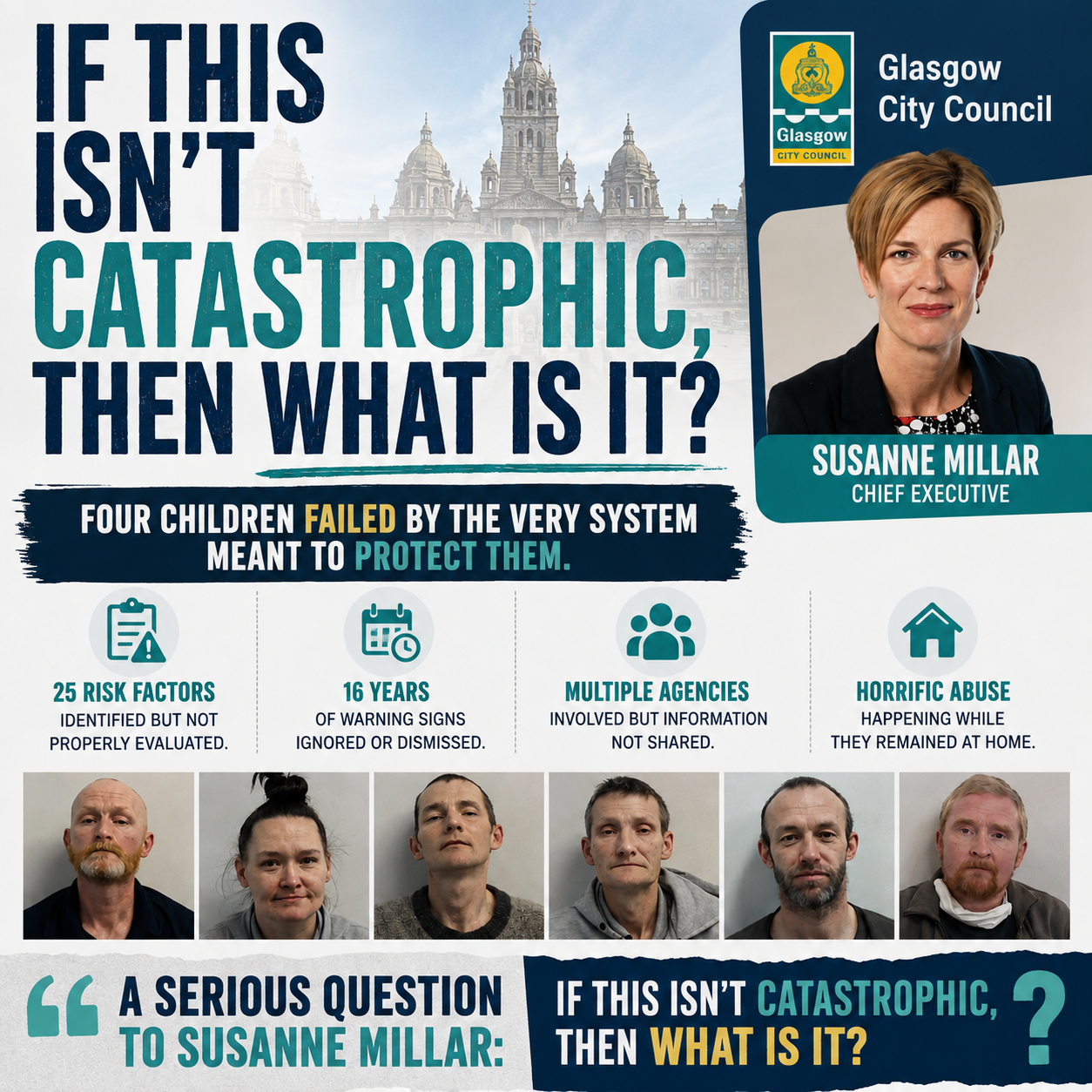
I have spent quite a bit of time reading the Glasgow Family C learning review, and I have to be honest, this one hits differently for me. I was a child who was abused, and I was also a child surrounded by risk factors that should have been recognised, followed up, communicated and acted upon. I know what it feels like to have concerns around you that adults should be joining together, and I know what it feels like when the system that is supposed to protect you doesn’t do enough. So when I read this report, I am not reading it as just another council document. I am reading it as somebody who knows what it means to be the child at the centre of these decisions.
That is why Susanne Millar’s comments about the use of the word “catastrophic” have really got under my skin. I understand that, technically, the independent review does not use the exact phrase “catastrophic failures”. But after actually reading what the review found, I have to ask: Susanne Millar, what exactly does catastrophic look like to you?

The Family C review covers sixteen years in the lives of four children. Their family had been known to services since 2007, with involvement from social work, health, education, addictions services, dental services, police, homelessness services and voluntary organisations. This was not a family that suddenly appeared on the radar in 2019. There was a long history of professional involvement and a huge amount of information about these children’s lives.
The warning signs started very early. Child A was placed on the Child Protection Register shortly after birth because of concerns about physical neglect and was briefly accommodated in foster care when her mother’s drug use relapsed. There were later concerns about drug use, non-engagement, self-harm, the children’s distress and serious dental problems. Child A eventually had six teeth extracted, while Child B also had significant dental problems and untreated toothache.
By 2012, Child A needed another six teeth removed under general anaesthetic. The family failed to engage with support, there were persistent headlice concerns and, by the end of 2013, both children had obvious dental decay alongside repeated failures to attend appointments for different health needs. Despite this, social work closed the case in September 2013.
The report later identifies 25 risk factors but says they were not properly prioritised or evaluated. It also found that professionals became too focused on the parents engagement, particularly around addiction, and sometimes treated apparent progress by the adults as evidence that the children were becoming safer when there was little evidence that their actual lives were improving.
That distinction is massive. A parent attending an appointment is not the same thing as a child being safe. A parent promising to change is not the same as sustained change. Yet the review found that parents could be described as “doing their best” despite a pattern of missed health and dental appointments, avoidance of home visits and incomplete interventions. The NSPCC, for example, delivered only 13 of 34 planned sessions, with 18 cancelled by the parents.
There were also very obvious signs of neglect. The report records concerns about hunger, poor hygiene, dirty clothing, headlice, poor home conditions and unmet medical and dental needs. One child told professionals that he did not feel safe at home and did not have enough to eat. There were children showing distress, but the review found that professionals did not always look beyond their behaviour to ask what that behaviour might actually be communicating.
One of the children later told the reviewers that professionals needed to speak to children more, away from their parents, watch how they behaved and pay attention to the little things. Another said that people had not understood what was happening because they were the person actually living through it. That is a devastating thing for a child to have to explain after the fact.
The review also found that information was not being properly brought together. There was no multi-agency chronology of significant events throughout the period being examined, meaning that important information could remain scattered between services instead of being viewed as one developing picture. The report found that professionals were too often concentrating on individual events and immediate circumstances rather than the cumulative evidence of what these children’s lives were actually like.
Even the language used in records could hide the seriousness of what was happening. The review points out that professional terms such as “malodorous” could make the reality less obvious than descriptions from community organisations of children with blackened, decayed teeth, smelling of urine or wearing unwashed clothes. The report says this professionalised language could dilute the severity of concerns.
By 2018, there was significant involvement from child protection services, including weekly planned and unannounced visits, core group meetings, Cordia support and NSPCC involvement. Yet the children’s circumstances still did not improve sufficiently. There was also a serious delay in the referral to SCRA. Although a child protection conference decided in July 2018 that a referral should be made, it was not submitted until September, and the eventual decision took 111 working days when the expected timeframe was 50. Managers were unaware of the delay, and the case was not escalated when concerns continued to increase.
The review describes that eventual SCRA decision as seriously flawed and says that the lack of care and lack of improvement for the children within the voluntary child protection framework was “abundantly clear”. The children were eventually removed from their parents in June 2019, but the review makes clear that most of the concerns present at that point had already been present in 2018 and, in many cases, for years.
It was after the children were removed that the full horror of what they had experienced began to emerge. They disclosed serious physical and emotional abuse, neglect, drug use in the home, repeated terrorising abuse, sexual abuse, being forced to take drugs and the involvement of other adults. Their parents were subsequently convicted of multiple offences arising from the abuse. The review specifically identifies the period between 2018 and June 2019 as particularly significant because much of the group sexual abuse was taking place during that time.
I want to be fair about something here, because I think it is important. The report does not say that professionals knew these children were being sexually abused and simply ignored it. It acknowledges that sexual abuse can be extremely difficult to identify before a child discloses it. What it does say is that professionals knew these children were vulnerable, knew their needs were not being met and failed to properly understand the cumulative picture. That failure contributed to the children remaining at home for longer.
There were problems even after the children were finally safe. Child A was subjected to 32 interview sessions across 13 days, while Child B took part in 17 sessions across 12 dates. Professionals raised concerns about the impact of the interviews, and the review found there were not enough opportunities for everyone involved to stop, take stock and properly consider what was in the children’s best interests.
The report does contain examples of professionals doing things well, and I think that should be acknowledged. Police, social work, SCRA and CAMHS staff worked hard to support the children, and some professionals clearly advocated strongly for them. The problem was not that every person involved failed these children. The problem was that the wider system did not consistently allow concerns to be brought together, challenged or acted upon effectively.
The recommendations themselves tell us just how much learning the review found was necessary. It says the child’s voice and experience must be central to assessment and decision-making, professional opinions must be backed up by factual evidence about the child’s health and safety, managers must demonstrate proper oversight and accountability, and staff must be confident in recognising neglect as harm.
So yes, Suzanne Millar, perhaps the report does not use the word “catastrophic”. But I am struggling to understand why that seems like the important point to make when the report describes sixteen years of professional involvement, 25 identified risk factors, chronic neglect, serious health problems, missed opportunities, failures to properly join information together, delays in intervention and four children who ultimately suffered horrific abuse.
For me, this is not an abstract argument. I was a child who was abused, and I know what it feels like when there are risk factors around you that should be taken seriously but aren’t followed through properly. I know what it feels like when adults have information about your life that, if properly joined together, might tell a very different story. That is why I cannot look at this report and simply get caught up in whether one adjective is technically appropriate.
The children deserved better than that, and every child who comes into contact with Children and Families services deserves better than that. They deserve adults who will listen, communicate, challenge one another and, most importantly, look at what is actually happening to the child rather than becoming distracted by whether the adults around them appear to be engaging.
So, Susanne Millar, if four children surrounded by years of warning signs, 25 identified risk factors, serious neglect, missed opportunities and horrific abuse does not meet your definition of catastrophic, then perhaps the problem is not the word “catastrophic” perhaps it is how catastrophically low your threshold for failure has become.
https://www.thescottishsun.co.uk/news/16724029/scots-council-boss-savaged-over-paedo-fiasco
https://hollyalex.co.uk/wp-content/uploads/2026/08/Learning_Review_Report_-_Family_C.pdf