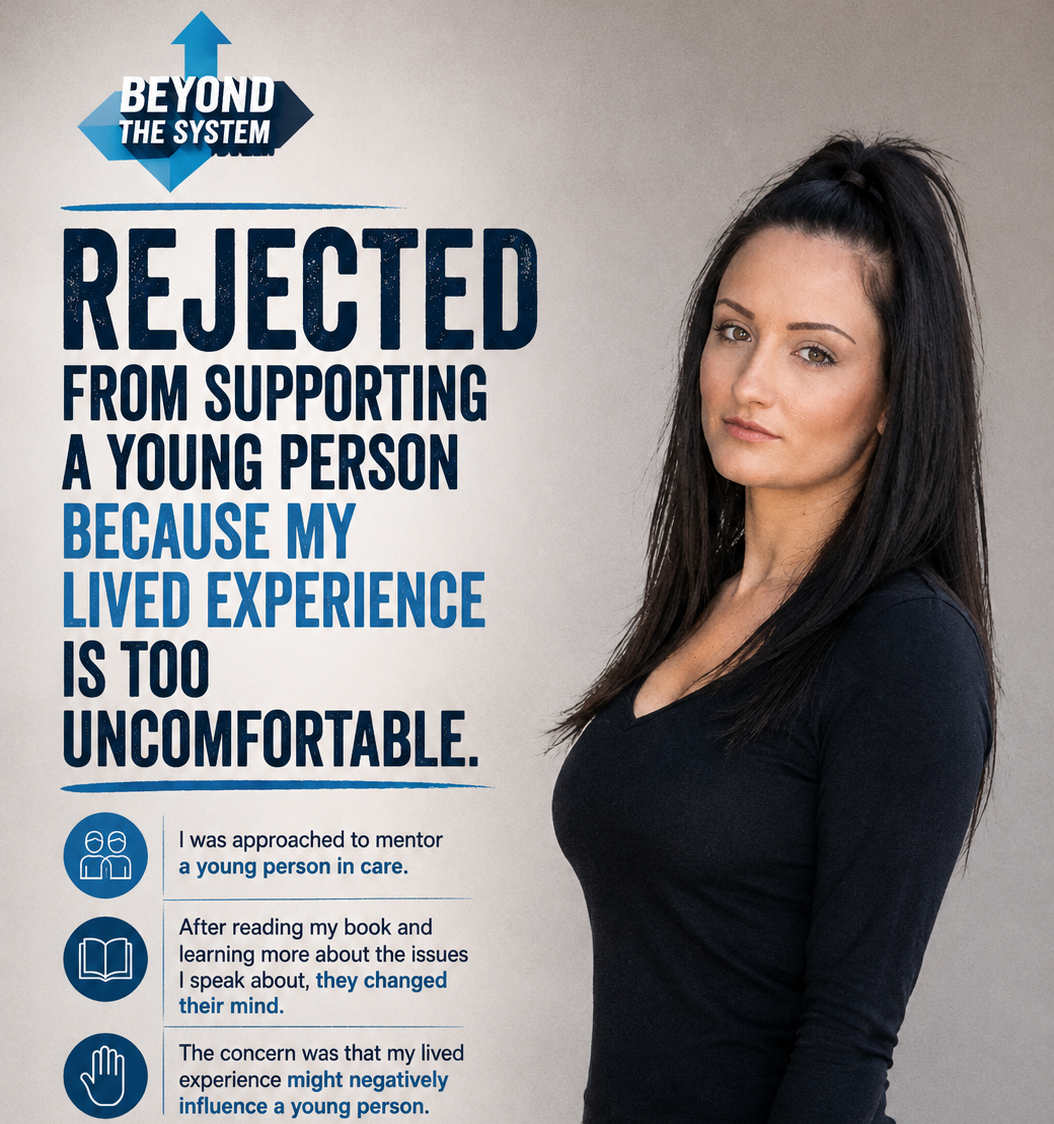
Recently, I was approached by a service provider that works with young people currently in care.
They had heard about me, knew about the work I’ve been doing, and wanted to speak to me about becoming a one-to-one mentor or befriender for a looked after young person.
It felt like exactly the kind of opportunity I’d hoped for and been working towards.
Everything I’ve written, spoken about and advocated for has always come back to one thing, Improving the lives of children and young people in care. The chance to support one young person on a more personal level felt like a privilege.
Our conversation was warm, open and encouraging. Until later in the day, when I received an email.
They explained that, after reading more about my work, my book and some of the topics I’ve spoken about publicly, they told me they had concerns.
Not about my character, not about my ability to build relationships and not about my intentions.
Their concern was that my views of the care system could negatively influence a young person. They explained that looked after children are particularly susceptible to influence and that, because my own experience of care had been so horrendous, I could unintentionally put negative ideas into their heads. I was shocked.
Of course, my experience isn’t every young person’s experience. I’ve never claimed it was. Care is not one single story. Some children experience love, stability and lifelong relationships. Others experience instability, trauma and loss. Many experience something in between.
My book has never claimed to represent every child in care.
It represents me.
What hit me most, though, was the assumption behind the concern. It seemed to suggest that my role as a mentor would somehow be to impress my own views of the care system onto a young person.
That couldn’t be further from the truth.
Anyone who understands mentoring knows it isn’t about telling someone what to think. It isn’t about sitting opposite a young person and saying, “The care system is broken,” or trying to convince them that their experience should mirror mine.
A mentor’s role is to listen before they speak.
To build trust.
To encourage.
To support.
Sometimes it’s simply about being a consistent adult who shows up, listens without judgement and reminds a young person that someone is in their corner.
If a young person wanted to talk about their experiences of care, I would listen. If they asked for my perspective, I would answer honestly. But I would never tell them what they should think about their own lives or experiences.
Every young person’s story belongs to them, just as mine belongs to me.
Ironically, every mentor influences a young person. That’s the whole point of mentoring.
The question isn’t whether you have influence.
The question is how you use it.
Good mentors don’t influence through ideology or opinion. They influence through empathy, consistency, compassion, honesty and respect. They help young people find their own voice, not replace it with someone else’s.
What I find difficult to understand is why lived experience is celebrated until it becomes uncomfortable. And I have experienced this sadly from even some of our widely known care experienced organisations.
Organisations often say they value people with lived experience. They invite us onto panels. They ask us to share our stories. They encourage us to speak openly.
But sometimes it feels as though those voices are only welcome when they reinforce the narrative people are already comfortable with.
The moment a story exposes uncomfortable truths or asks difficult questions, it suddenly becomes something to manage rather than something to learn from.
That isn’t listening, it’s gatekeeping. The implication behind this conversation has stayed with me.
If a young person hears my story and recognises parts of their own, I haven’t put those thoughts into their head.
They were already living them.
I’ve simply given words to an experience that can often feel isolating.
And if another young person hears my story and can’t relate to it at all, that’s equally valid and honestly, I’m glad.
Their experience deserves to be heard just as much as mine does.
What saddened me most wasn’t that someone disagreed with my perspective.
Healthy disagreement is important.
What saddened me was the suggestion that young people in care should be protected from hearing an honest account of someone else’s lived experience, as though they are incapable of hearing different perspectives and making up their own minds.
I think we should give them far more credit than that.
Young people are thoughtful, perceptive and capable of critical thinking. They don’t need adults deciding which stories they’re allowed to hear. They need adults who are willing to listen to theirs.
Protecting young people should never mean protecting systems from criticism.
My book isn’t an attack on every social worker or every organisation.
It’s an honest account of what happened to me.
Nothing more.
Nothing less.
If an honest story makes people uncomfortable, perhaps the problem isn’t the story.
Perhaps it’s what the story asks us to confront.
Because if lived experience is only welcomed when it’s positive, when it’s tidy, and when it reassures people that the system works, then we aren’t really valuing lived experience at all.
We’re curating it. And those are two very different things.